
Thermionic emission is the process by which free electrons are emitted from the surface of a metal when it is heated to a high temperature. Often referred to as the Edison Effect, this phenomenon forms the foundation of modern vacuum tube electronics, cathode-ray tubes, and advanced imaging technology like X-ray machines.
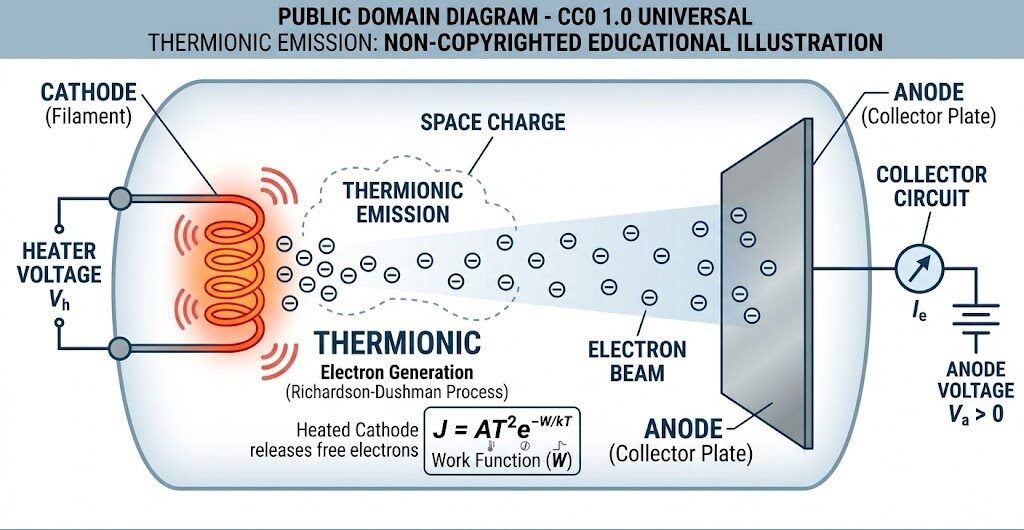
Thermodic mission ki non copyrighted image banaa do
Electron beam generated via thermionic emission in a Cathode Ray Tube. Source: jack0m / Getty Images
How Thermionic Emission Works
In metals, free electrons move continuously within the atomic lattice, held inside by electrostatic attractive forces. The minimum amount of energy required for an electron to break free from this surface barrier is called the metal’s Work Function (ϕ).
- Thermal Energy Input: When electrical current passes through a filament (cathode), electrical resistance converts energy into heat.
- Kinetic Gain: Thermal kinetic energy transfers to free electrons inside the metal.
- Overcoming Work Function: When thermal energy exceeds the work function (Ek≥ϕ), electrons overcome the potential barrier and boil off into surrounding space.
- Space Charge Formation: Emitted electrons form an electron cloud around the cathode, ready to be accelerated towards a positively charged anode.
Key Factors Governing Emission
The rate of electron emission depends on three primary variables:
- Temperature (T): Higher filament temperatures exponentially increase electron emission rate.
- Work Function (ϕ): Metals with lower work functions (such as Thoriated Tungsten or Barium Oxide coatings) emit electrons at significantly lower temperatures.
- Surface Area (A): Larger surface areas provide more emission sites for free electrons.
The Governing Equation: Richardson-Dushman Law
The emission current density (J) is mathematically modeled by the Richardson-Dushman equation:
J=A0T2e−kBTϕ
| Variable | Description |
|---|---|
| J | Emission current density (A/m2) |
| A0 | Richardson’s constant (≈1.2×10⁶ A/m2K2) |
| T | Absolute temperature (K) |
| ϕ | Work function of the material (eV) |
| kB | Boltzmann constant |
Major Real-World Applications
- Medical X-Ray Tubes: Thermionic emission generates high-velocity electron streams that strike a heavy metal target (tungsten) to produce diagnostic X-rays.
- Scanning Electron Microscopes (SEM): Thermionic guns act as electron sources to capture nanometer-scale surface detail.
- Amplifiers & Vacuum Tubes: Found in specialized audio equipment and radar high-power transmitters.
- Cathode Ray Tubes (CRT): Historical displays and oscilloscopes used thermionic guns to drive phosphorescing screens.
Thermionic Emission vs. Photoelectric Emission
While both processes involve emitting free electrons from a material’s surface, they differ fundamentally in the energy source used to overcome the metal’s work function.
- Thermionic Emission relies on thermal energy (heat) to excite electrons, making the process temperature-dependent and relatively continuous.
- Photoelectric Emission relies on radiant energy (photons/light) above a threshold frequency, resulting in instantaneous electron ejection regardless of temperature.
| Parameter | Thermionic Emission | Photoelectric Emission |
|---|---|---|
| Primary Energy Source | Heat / Thermal energy | Light / Electromagnetic radiation (Photons) |
| Governing Condition | High surface temperature (T) | Light frequency above threshold (f≥f0) |
| Response Time | Delayed (requires heating time) | Instantaneous (≈10−9 seconds) |
| Emission Control | Controlled by filament current & temperature | Controlled by light intensity and frequency |
| Operating Temperature | High temperatures required | Can occur at room temperature |
| Primary Mathematical Law | Richardson-Dushman Law | Einstein’s Photoelectric Equation |
| Core Applications | X-Ray tubes, Vacuum tubes, Electron microscopes | Photovoltaic solar cells, Light sensors, Digital camera sensors |
0 responses on "Understanding Thermionic Emission: How Heated Metals Generate Free Electrons"